
Continental Union
Letter 86
Kind Reader,
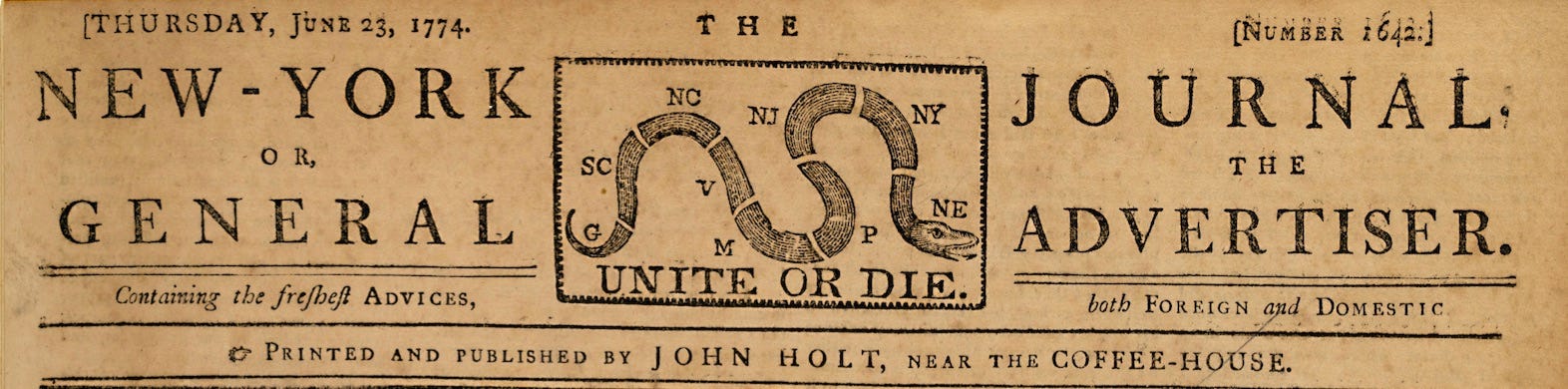
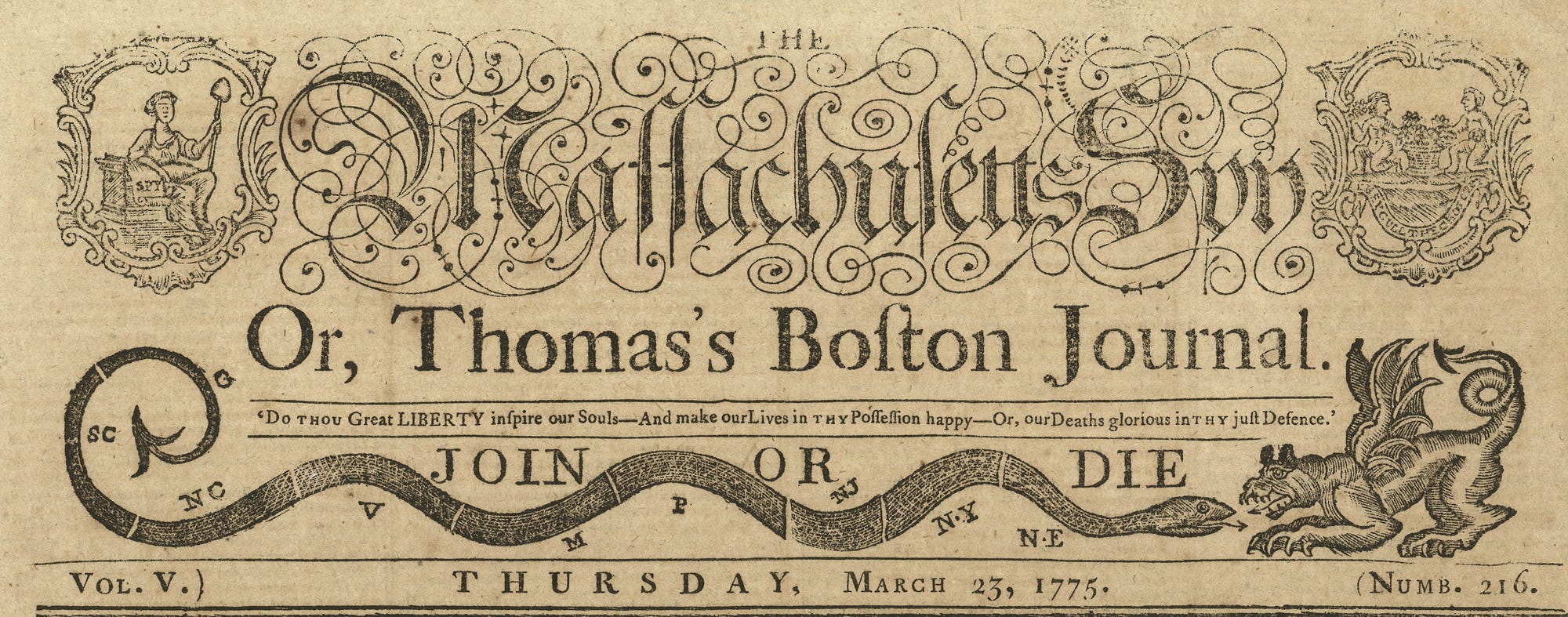
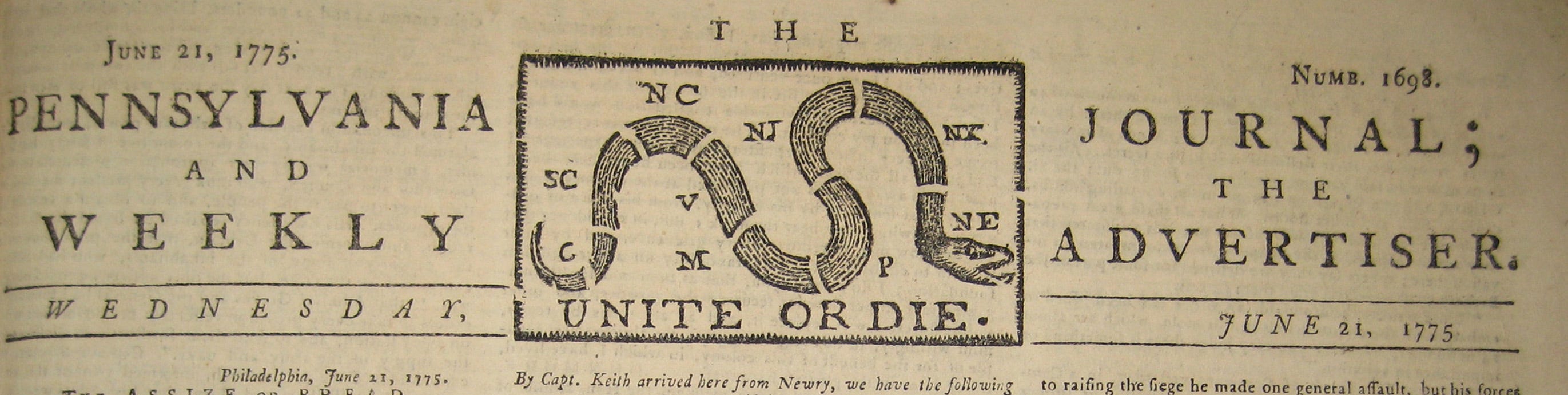
To see the colonies joined together into a firmer union with each other has been a desire of mine for nearly forty years. I was first able to propose such a union at the congress held at Albany in 1754. I supported the plan in my newspaper with my drawing of a dissected serpent, which was resurrected twenty years later and has been an encouragement to continental union ever since. Now, at last, with the new federal constitution, which resembles in several ways my original plan of union, I see that desire fulfilled.
Today I give you a paper I drew up at the time, or that part of the paper which has not been lost, concerning the reasons I though a binding and perpetual union of the several colonies was desirable. Though our affairs are much altered from those days, and the French no longer our enemies, yet I think many of the reasons recommending union remain as sound as ever. Few, I think, would disagree that in union we are strong, and divided we are weak; yet how union is best to be achieved and maintained remains a question. I am
your friend and humble servant,
B. Franklin
________________________________
Albany – July 10,1754.
I. Reasons and motives on which the plan of union was formed.
The commissioners from a number of the northern colonies being met at Albany, and considering the difficulties that have always attended the most necessary general measures for the common defense, or for the annoyance of the enemy, when they were to be carried through the several particular assemblies of all the colonies: some assemblies being before at variance with their governors or councils, and the several branches of the government not on terms of doing business with each other; others taking the opportunity, when their concurrence is wanted, to push for favorite laws, powers, or points that they think could not at other times be obtained, and so creating disputes and quarrels; one assembly waiting to see what another will do, being afraid of doing more than its share, or desirous of doing less; or refusing to do anything, because its country is not at present so much exposed as others, or because another will reap more immediate advantage; -- from one or other of which causes, the assemblies of six (out of seven) colonies applied to, had granted no assistance to Virginia, when lately invaded by the French, though purposely convened, and the importance of the occasion earnestly urged upon them.
Considering moreover, that one principal encouragement to the French, in invading and insulting the British American dominions, was their knowledge of our disunited state, and of our weakness arising from such want of union; and that from hence different colonies were, at different times, extremely harassed, and put to great expense both of blood and treasure, who would have remained in peace, if the enemy had had cause to fear the drawing on themselves the resentment and power of the whole; the said Commissioners, considering also the present encroachments of the French, and the mischievous consequences that may be expected from them, if not opposed with our force, came to an unanimous resolution:
That an union of the colonies is absolutely necessary for their preservation.
The manner of forming and establishing this union was the next point. When it was considered that the colonies were seldom all in equal danger at the same time, or equally near the danger, or equally sensible of it; that some of them had particular interests to manage, with which an union might interfere; and that they were extremely jealous of each other; it was thought impracticable to obtain a joint agreement of all the colonies to an union, in which the expense and burden of defending any of them should be divided among them all; and if ever acts of assembly in all the colonies could be obtained for that purpose, yet as any colony, on the least dissatisfaction, might repeal its own act and thereby withdraw itself from the union, it would not be a stable one, or such as could be depended on: for if only one colony should, on any disgust, withdraw itself, others might think it unjust and unequal that they, by continuing in the union, should be at the expense of defending a colony which refused to bear its proportionable part, and would therefore one after another, withdraw, till the whole crumbled into its original parts. Therefore the commissioners came to another previous resolution, viz.
That it was necessary the union should be established by Act of Parliament.
They then proceeded to sketch out a plan of union, which they did in a plain and concise manner, just sufficient to show their sentiments of the kind of union that would best suit the circumstances of the colonies, be most agreeable to the people, and most effectually promote His Majesty’s service and the general interest of the British Empire. This was respectfully sent to the assemblies of the several colonies for their consideration, and to receive such alterations and improvements as they should think fit and necessary; after which it was proposed to be transmitted to England to be perfected, and the establishment of it there humbly solicited.
This was as much as the commissioners could do.
II. Reasons against partial unions.
It was proposed by some of the Commissioners to form the colonies into two or three distinct unions; but for these reasons that proposal was dropped even by those that made it:
1. In all cases where the strength of the whole was necessary to be used against the enemy, there would be the same difficulty in degree, to bring the several unions to unite together, as now the several colonies; and consequently the same delays on our part and advantage to the enemy.
2. Each union would separately be weaker than when joined by the whole, obliged to exert more force, be more oppressed by the expense, and the enemy less deterred from attacking it.
3. Where particular colonies have selfish views, as New York with regard to Indian trade and lands; or are less exposed, being covered by others, as New Jersey, Rhode Island, Connecticut, Maryland; or have particular whims and prejudices against warlike measures in general, as Pennsylvania, where the Quakers predominate; such colonies would have more weight in a partial union, and be better able to oppose and obstruct the measures necessary for the general good, than where they are swallowed up in the general union.
4. The Indian trade would be better regulated by the union of the whole than by partial unions. And as Canada is chiefly supported by that trade, if it could be drawn into the hands of the English, (as it might be if the Indians were supplied on moderate terms, and by honest traders appointed by and acting for the public) that alone would contribute greatly to the weakening of our enemies.
5. The establishing of new colonies westward on the Ohio and the lakes, (a matter of considerable importance to the increase of British trade and power, to the breaking that of the French, and to the protection and security of our present colonies,) would best be carried on by a joint union.
6. It was also thought, that by the frequent meetings-together of commissioners or representatives from all the colonies, the circumstances of the whole would be better known, and the good of the whole better provided for; and that the colonies would by this connection learn to consider themselves, not as so many independent states, but as members of the same body; and thence be more ready to afford assistance and support to each other, and to make diversions in favor even of the most distant, and to join cordially in any expedition for the benefit of all against the common enemy.
These were the principal reasons and motives for forming the plan of union as it stands. To which may be added this, that as the union of the ...
___________________
The remainder of this article is lost.
p.s. By the end of 1754, I had already come to despair that colonies would set aside their differences and act in their own interests. On December 29, I wrote as follows to my English friend Peter Collinson of my hope that King George’s ministers would act to unite America. This they eventually did, though not in the way I imagined in 1754!
As to the state of the colonies, a pretty full representation of it was drawn up by the commissioners at Albany, and was sent home to the Ministry with the proceedings. … All the assemblies in the colonies have, I suppose, had the union plan laid before them; but it is not likely, in my opinion, that any of them will act upon it so as to agree to it, or to propose any amendments to it. Everybody cries, a union is absolutely necessary; but when they come to the manner and form of the union, their weak noddles are presently distracted. So if ever there be an union, it must be formed at home by the Ministry and Parliament. I doubt not but they will make a good one, and I wish it may be done this winter.
This episode of history is rich with irony considering what happened 2 decades later.