
Good Cents
Letter 95
Kind Reader,
The American Congress began as a consultative body, delegates from the several colonies gathered to discuss their common concerns, and perhaps arrive at means by which, through co-operation, they could obtain certain desirable ends, ends that they could not hope to obtain acting singly. When war commenced between the colonies and their mother country, the Congress began to act as though it were a government, and in doing so incurred numerous expenses as it tried to, in the most obvious case, recruit, equip, and pay an army. The Congress could request money be given it by the several provinces, but it could in no wise compel them to give it. And there was much carping among the people who objected to the Congress “taking money from their pockets” even to pay just debts incurred on their behalf.
So the Congress hit upon the simple expedience of printing money. Patriotic citizens were expected to accept these paper notes in payment with the understanding that they would one day be redeemed by the Congress for good silver coin, specifically in Spanish dollars, the most common coins in all the Americas.
I was sole master of my own printing house in Philadelphia from 1728 to 1748, at which time I entered into partnership with my journeyman David Hall, creating the firm of Franklin and Hall. In return for the partnership, Mr. Hall undertook to conduct all the common affairs of the business, I receiving a share of the profits for the next 18 years, at which time Mr. Hall was to become full owner of the shop. I reckoned I would be sixty years old by that time, and would likely have enough to live upon in whatever few years I had left after that. When the printing office devolved to Mr. Hall in 1766, he took on a new partner of his own, and the firm of Hall and Sellers was formed.
When the Congress resolved, in May of 1775, to begin printing their own money, I recommended Hall and Sellers to do the printing. The first “Continental” notes were put to use in August of that same year. I myself worked out the design for some of these first notes, such as this one for one, a sixth of a dollar being about equal to a British shilling.
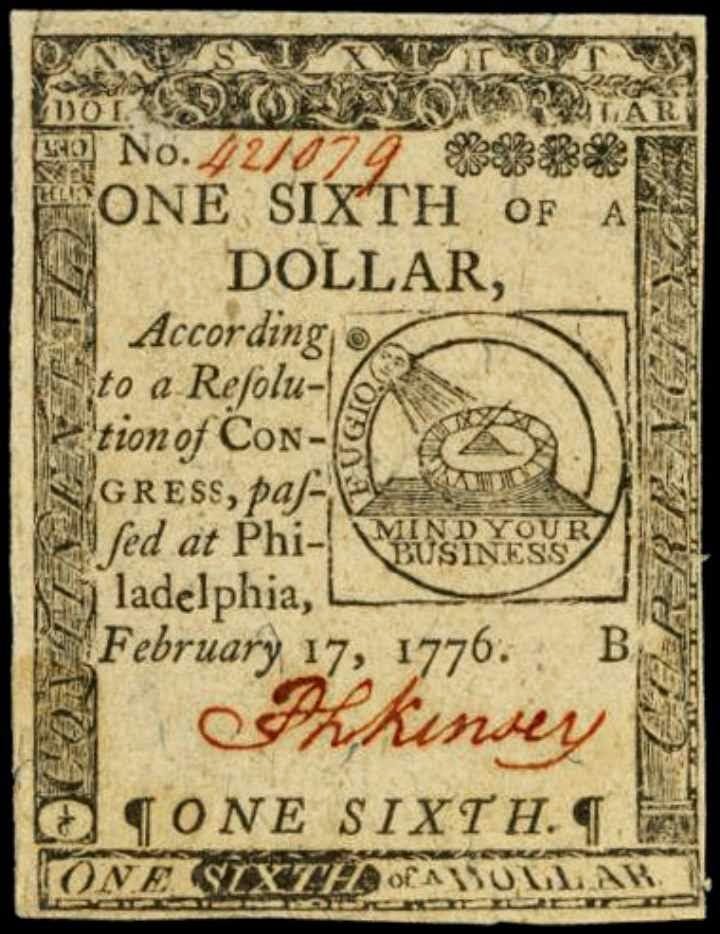
The front of the note shows a sundial with the sun shining upon it. The Latin word “FUGIO” (“I fly”) appears beside the dial, and beneath are the words MIND YOUR BUSINESS. I thought the meaning would be clear to any who saw it: a reminder of the swift passage of time, with an admonition to make the best use of it for the good of yourself and others. “Time is short, waste it not.” Alas, I have been told that many people have ignored the sundial, and interpreted that MIND YOUR BUSINESS as a sort of churlish “stay out of my affairs; mind your own business.”
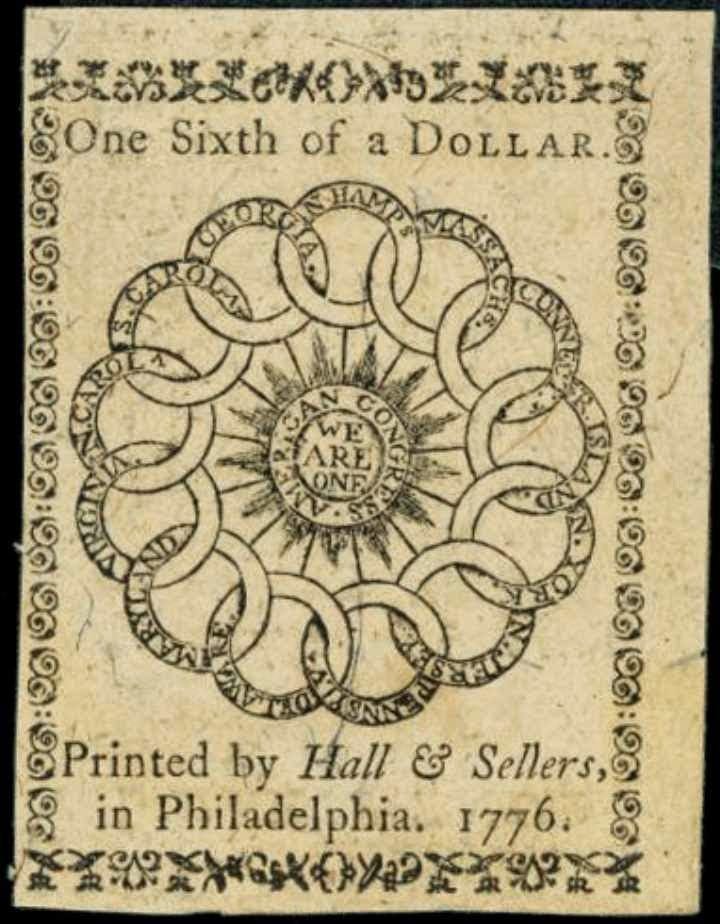
The design on the back of the note is better understood: a circular chain of 13 links, one for each colony, with AMERICAN CONGRESS written in the middle surrounding the words WE ARE ONE. I have been asked where I had the idea for the chain, and was it inspired by the metaphorical chain that binds the Six Nations of Indians together. In honesty, I don’t remember, but think it a fine device.
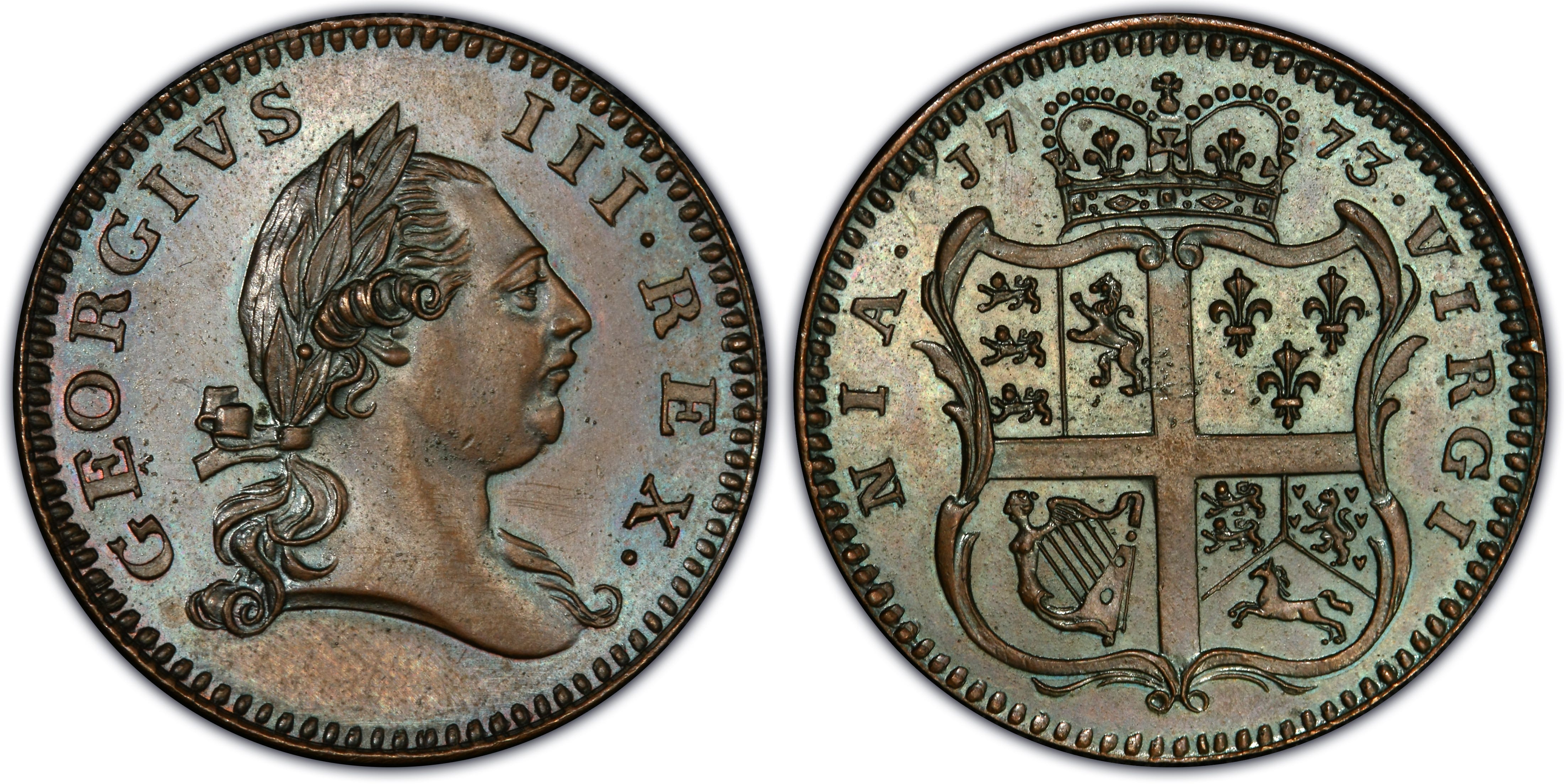
Britain found it difficult to produce coins enough for Britain itself, and no coins were struck for the colonies until a few were made for Virginia in 1773, as you see above; and never was there any thought of Britain establishing a mint in America. Spain began minted coins in Mexico in 1536, and by the time of our independence had mints striking very fine coins throughout its American dominions, at Mexico, Lima, Potosi, Guatemala, and Santiago. Coins minted in these places were sometimes shipped to Spain to be used, but also frequently came up in trade from the Caribbean to the English colonies of North America. In time, when Congress devised a system of money for the new United States, they adopting the Spanish dollar as its first unit. Here is one of those dollars, or pieces-of-eight as they are also called.
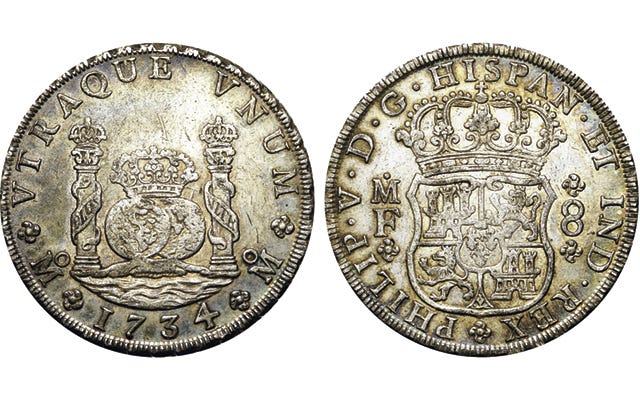
The Spanish divide their dollar (or “peso” as they called it) into eight bits (“reales”) and you can see the number 8 on the coin; Mr. Jefferson and others thought it more convenient to divide our dollar into ten “dimes” and the dimes into ten “cents” and that was the system finally adopted by the United States. Spanish dollars and their fractions will no doubt continue long in use in this country along with our own coins, with their dollar esteemed of the same value as ours; their half dollar or four-bit piece the same as our new fifty-cent piece, and their quarter dollar, or two-bit piece, the same as our new 25-cent coin.
Though our own mint, to be erected in Philadelphia, is not yet at work, first attempts at a truly American coinage have already been made. Since 1783, various firms, in England and America, have produced coppers for the United States in various designs though in small numbers, each hoping for a contract to produce more. Several states are striking their own cents: Connecticut, Massachusetts, Vermont, New York, and New Jersey. In 1787, Mr. James Jarvis of New Haven was commissioned by the Congress to produce our first official cents, made in copper, and of a value similar to the familiar English half penny.
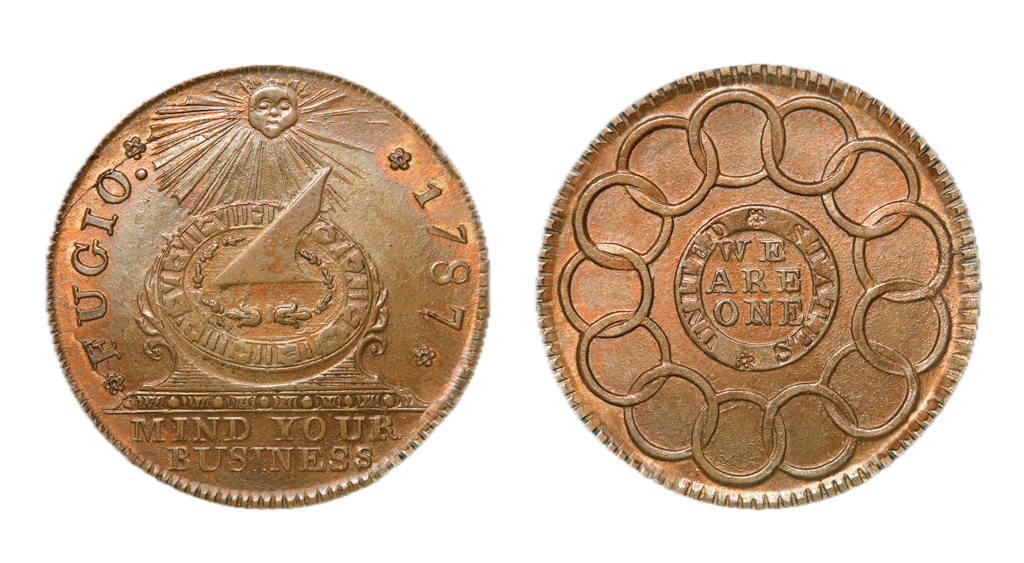
As you can see, the design for this first American cent was taken from my early Continental notes, the greatest alteration being the substitution of UNITED STATES on the coin for the words AMERICAN CONGRESS on the note.
During the war, and while I was in France, I wrote a letter to my London friend Edward Bridgen describing the sort of copper coins that might be useful in our new country. Now that our independence is secure, I have had second thoughts about decorating our coins with images of British atrocities, but the notion that they may be used to inculcated moral principles still seems to be of value to
your friend and servant,
B. Franklin
_____________________________
Passy — October 2, 1779.
Dear Sir,
I received your favor of the 17th past, and the two samples of copper are since come to hand. The metal seems to be very good, and the price reasonable, but I have not yet received the orders necessary to justify my making the purchase proposed.
There has indeed been an intention to strike copper coin that may not only be useful as small change, but serve other purposes. Instead of repeating continually upon every halfpenny the dull story that everybody knows, and what it would have been no loss to mankind if nobody had ever known, that George III is King of Great Britain, France, & Ireland, &c. &c. to put on one side some important proverb of Solomon, some pious moral, prudential or œconomical precept, the frequent inculcation of which by seeing it every time one receives a piece of money, might make an impression upon the Mmnd, especially of young persons, and tend to regulate the conduct; such as on some, The Fear of the Lord is the Beginning of Wisdom; on others, Honesty is the Best Policy; on others, He that by the Plow Would Thrive; Himself Must Either Lead or Drive. On others, Keep thy Shop & Thy Shop Will Keep Thee. On others, a Penny Saved Is a Penny Got. On others, He that Buys what He has No Need of, Will Soon Be Forced to Sell His Necessaries. On others, Early to Bed & Early to Rise, Will Make a Man Healthy, Wealthy, & Wise. And so on to a great variety.
The other side it was proposed to fill with good designs drawn and engraved by the best artists in France of all the different species of barbarity with which the English have carried on the war in America, expressing every abominable circumstance of their cruelty and inhumanity, that figures can express, to make an impression on the minds of posterity as strong and durable as that on the copper. This Resolution has been a long time forborne, but the late burning of defenseless towns in Connecticut, on the flimsy pretense that the people fired from behind their houses, when it is known to have been premeditated and ordered from England, will probably give the finishing provocation, and may occasion a vast demand for your metal.
I thank you for your kind wishes respecting my health. I return them most cordially fourfold into your own bosom.
Adieu,
B. Franklin
_____________________________
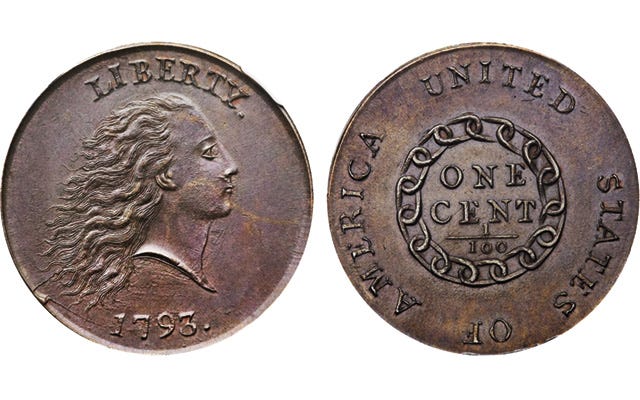
p.s. These are designs used for two of the earliest coins struck by the United States mint. I had an unintended part in these designs, but for that story you will have to look at Letter 40.
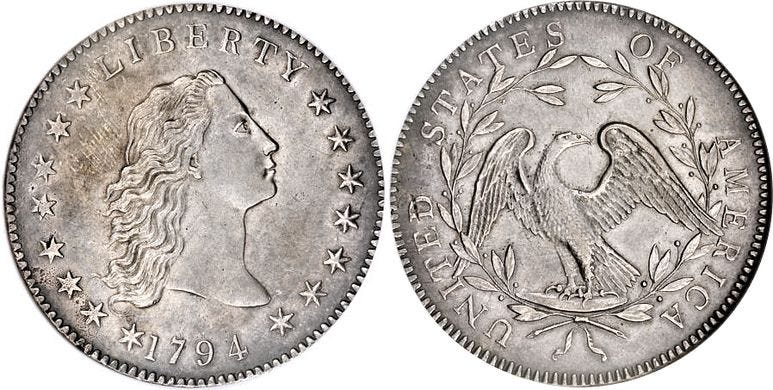
[ N.B. A few United States dollars were minted between 1794 and 1804, but the only new dollar coins that entered circulation here for the next thirty years were Spanish (and later, Mexican) dollars which were accorded the status of legal tender. In 1840 the U.S. began to mint its own dollars again in small numbers, but Spanish/Mexican coins continued to circulate at par — before, during, and after the Mexican-American War — though with decreasing frequency. Only in 1857 did the United States declare Mexican silver coins to no longer be legal tender in the United States. ]