
Great Britain Reduced
Letter 118
Kind Reader,
Though I counseled against it, the Stamp Act was passed on March 22, 1765. At the time, I knew not what furor it would raise in the colonies. As unwise as I thought it was, at the first I thought we should just have to bear it as best we might. I suspected it would cause such inconvenience and be so troublesome as to fall of its own weight in time, doing harm to commerce while failing to raise a revenue.
I soon discovered that my fellow countrymen were unwilling to wait, that the act was stirring up more trouble than I expected, and immediate repeal was after all the only solution. To that end, I designed and published an allegorical picture and, having it printed on cards, began to distribute it soon after the new year, at the same time that I testified before Parliament to, I hope, good effect. The Stamp Act was repealed on March 18, 1766, less than a year after its passage.
I accompanied the picture with an “explanation” and a “moral”. The following year, 1767, the allegory was reprinted in Philadelphia, with a somewhat longer and different explanation, written by another. Both explanations, along with the picture, are now provided to you, kind reader, by
your humble and obedient servant,
B. Franklin
___________________
The Original Explanation and Moral
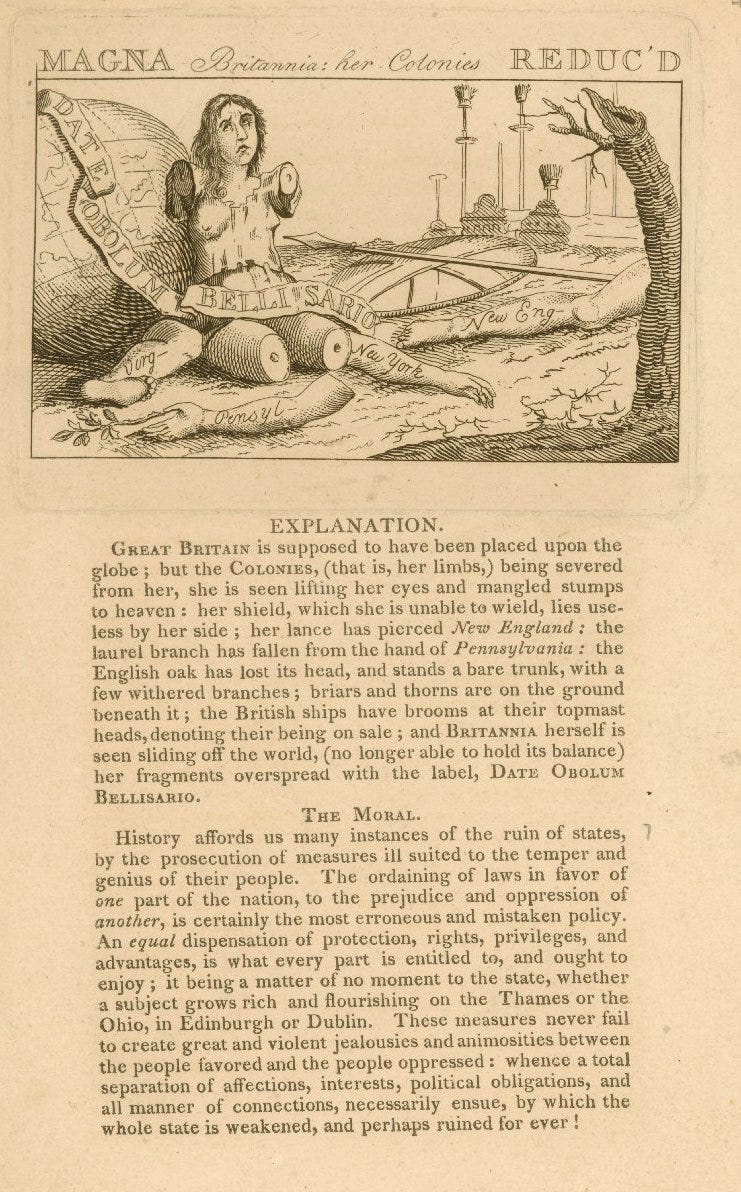
Explanation.
Great Britain [or Britannia] is supposed to have been placed upon the globe; but the colonies, (that is, her limbs,) being severed from her, she is seen lifting her eyes and mangled stumps to heaven; her shield, which she is unable to wield, lies useless by her side; her lance has pierced New England: the laurel branch has fallen from the hand of Pennsylvania: the English oak has lost its head, and stands a bare trunk, with a few withered branches; briars and thorns are on the ground beneath it; the British ships have brooms at their topmast heads, denoting their being on sale; and Britannia herself is seen sliding off the world, (no longer able to hold its balance) her fragments overspread with the label, “Date Obolum Belisario.” [The Latin motto means, in effect, “Have pity on Britain.”]
The Moral.
History affords us many instances of the ruin of states, by the prosecution of measures ill suited to the temper and genius of their people. The ordaining of laws in favor of one part of the nation, to the prejudice and oppression of another, is certainly the most erroneous and mistaken policy. An equal dispensation of protection, rights, privileges, and advantages, is what every part is entitled to, and ought to enjoy; it being a matter of no moment to the state, whether a subject grows rich and flourishing on the Thames or the Ohio, in Edinburgh or Dublin. These measures never fail to create great and violent jealousies and animosities between the people favored and the people oppressed: whence a total separation of affections, interests, political obligations, and all manner of connections, necessarily ensue, by which the whole state is weakened, and perhaps ruined forever!
___________________
The Philadelphia Explanation
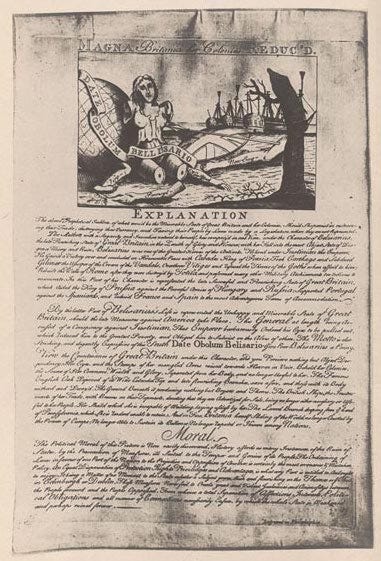
The above prophetical emblem, of what would be the miserable state of Great Britain and her colonies, should she persist in restraining their trade, destroying their currency, and taxing their people by laws made by a legislature, where they are not represented.
The author with a sagacity and invention natural to himself [sic], has comprised in one view, under the character of Belisarius, the late flourishing state of Great Britain, in the zenith of glory and honor; with her fall into the most abject state of disgrace, misery, and ruin.
Belisarius was one of the greatest heroes of the ancients. He lived under Justinian the Emperor. He gained a victory over, and concluded an honorable peace with, Cabades [Kavadh], King of Persia; took Carthage and subdued Gilimes [Gelimer] the usurper of the crown of the Vandals; overthrew Vitiges and refused the throne of the Goths when offered to him; rebuilt the walls of Rome after they were destroyed by Totila; and performed many other military achievements too tedious to enumerate. In this part of his character is represented the late successful and flourishing State of Great Britain, which aided the king of Prussia against the powerful armies of Hungary and Russia; supported Portugal against the Spaniards; and reduced France and Spain to the most advantageous terms of accommodation.
By the latter part of Belisarius’s life is represented the unhappy and miserable state of Great Britain, should the late measures against America take place. This general at length being accused of a conspiracy against Justinian, that emperor barbarously ordered his eyes to be pulled out, which reduced him to the greatest poverty, and obliged him to subsist on the alms of others. The motto is also striking, and elegantly expressive of this truth “Date Obolum Belisario”—”Give Poor Belisarius a Penny.”
View the countenance of Great Britain under this character, and you perceive nothing but abject despondency. Her eyes, and the stumps of her mangled arms raised towards Heaven in vain. Behold her colonies, the source of her commerce, wealth, and glory, separated from her body, and no longer useful to her. The famous English oak deprived of the wide extended top and late flourishing branches, save a few, and those with its body withered and decayed. The ground beneath it producing nothing but briars and thorns, the British ships, the instruments of her trade, with brooms on their topmasts, denoting that they are advertised for sale, being no longer either necessary or useful to her people. Her shield, which she is incapable of wielding, laying useless by her. The laurel branch dropping from the hand of Pennsylvania, which she is rendered unable to retain. And in fine, Britannia herself sliding off the world, no longer courted by the powers of Europe; no longer able to Sustain her balance; no longer respected or known among nations.
N.B. Modern historians discount the tale of Belisarius being blinded and left to beg, which arose centuries after the event.
Speaking the life & times of BF, I highly recommend the presentations at this Diane Sare for President event: https://sareforpresident.com/america-250-a-rededication/