
Immigrants in Congress
Letter 101
Kind Reader,
Though both Pennsylvanians, Mr. James Wilson and I were not always in perfect agreement. (In truth, what two gentlemen ever are?) Once, however, at the Grand Convention wherein our present Constitution was drafted, I found him to be a valuable ally.
A dispute arose about how soon immigrants from other countries should be eligible to serve in Congress. Mr. Gouveneur Morris moved that article V, section 3, be amended to require of new arrivals in America fourteen years citizenship before they are permitted to serve in the Senate, rather than the four years prescribed in the draft.
Charles Pinckney of South Carolina seconded the motion. Oliver Ellsworth of Connecticut opposed the motion, as discouraging meritorious aliens from emigrating to this country. Pinckney defended it, and was supported by George Mason of Virginia, who would have restricted eligibility to natives if not for the many foreigners who came to America during the war for independence and served with such credit. Mr. James Madison of Virginia opposed the amendment as being unnecessary and illiberal. Mr. Morris continued to defend it. He was supported by Pierce Butler of South Carolina.
I spoke in opposition to the motion, as did Mr. Edmund Randolph of Virginia, and also Mr. Wilson. Today I give you part of the minutes of that day’s debate.
______________
Philadelphia – August 9, 1787.
Dr. Franklin was not against a reasonable time, but should be very sorry to see anything like illiberality inserted in the Constitution. “The people in Europe are friendly to this country. Even in the country with which we have lately been at war, we have now and had during the war a great many friends, not only among the people at large, but in both houses of Parliament. In every other country in Europe all the people are our friends. We found in the course of the Revolution that many strangers served us faithfully, and that many natives took part against their country. When foreigners, after looking about for some other country in which they can obtain more happiness, give a preference to ours, it is a proof of attachment which ought to excite our confidence and affection.”
Mr. Randolph did not know whether it might be problematical whether emigrations to this country were, on the whole, useful or not, but he could never agree to the motion for disabling them for fourteen years to participate in public honors. He reminded the convention of the language held by our patriots during the Revolution, and the principles laid down in all our American constitutions. “Many foreigners have fixed their fortunes among us under the faith of these invitations. All persons under this description, with all others who would be affected by such a regulation, would enlist themselves under the banner of hostility to the proposed system.” He would go as far as seven years and no farther.
Mr. Wilson said that he rose with feelings that were perhaps peculiar, mentioning the circumstance of his not being a native, and the possibility that, if the ideas of some gentlemen should be pursued, of his being incapacitated from holding a place under the very constitution which he had shared the trust of making. He remarked the illiberal complexion which the motion should give to the system, and the effect a good system would have in inviting meritorious foreigners among us, and the discouragement and mortification they must feel from the degrading discrimination now proposed.
He had himself experienced this mortification. On his removal into Maryland, he found himself, from defect of residence, under certain legal incapacities which never ceased to produce chagrin, though he assuredly did not desire, and would not have accepted, the offices to which they related. “To be appointed to a place may be a matter of indifference. To be incapable of being appointed is a circumstance grating and mortifying.”
__________
Later I added, that there was no reason to suppose that, merely because a person has come here, applied for and obtained citizenship, and after a short time seeks public office, that he will naturally obtain it. Presumably, he should have first to obtain the confidence and trust of his neighbors, and if has not the merit to do so, his eligibility will be of no consequence.
Mr. Morris’s motion was defeated, seven states to four. Mr. Pinckney then proposed thirteen years, but the vote was the same. He proposed ten years, the vote was the same.
John Rutledge of South Carolina declared that as the draft requires seven years for the House of Representatives, the Senate ought to be longer, and proposed nine years. Hugh Williamson of North Carolina agreed. Edmund Randolph said that he would agree to nine after all, pending reconsideration of the seven years required for the House. If the proposal of James Wilson that the seven year requirement be reconsidered should result in the lowering of that number, then Mr. Randolph expected the Senate number would be lowered in proportion.
A vote was taken.
New Jersey, New Hampshire, South Carolina, and Georgia supported nine years as they had supported ten, thirteen, and fourteen.
Pennsylvania, Massachusetts, Connecticut, and Maryland opposed, as they had opposed the earlier attempts to lengthen the number from four years.
South Carolina, which had opposed the higher numbers was now divided. But Virginia (with Edmund Randolph’s assistance) and Delaware changed their votes, throwing the majority into the “aye” column, and the draft was amended to read nine years.
Mr. Wilson’s attempt to shorten the seven years for the House failed. And so the Constitution provides that no person may serve in the House without having been a citizen at least seven years, nor in the Senate with less than nine years of citizenship, though these numbers are considerably higher than was the preference of either James Wilson or
your humble and obedient servant,
B. Franklin
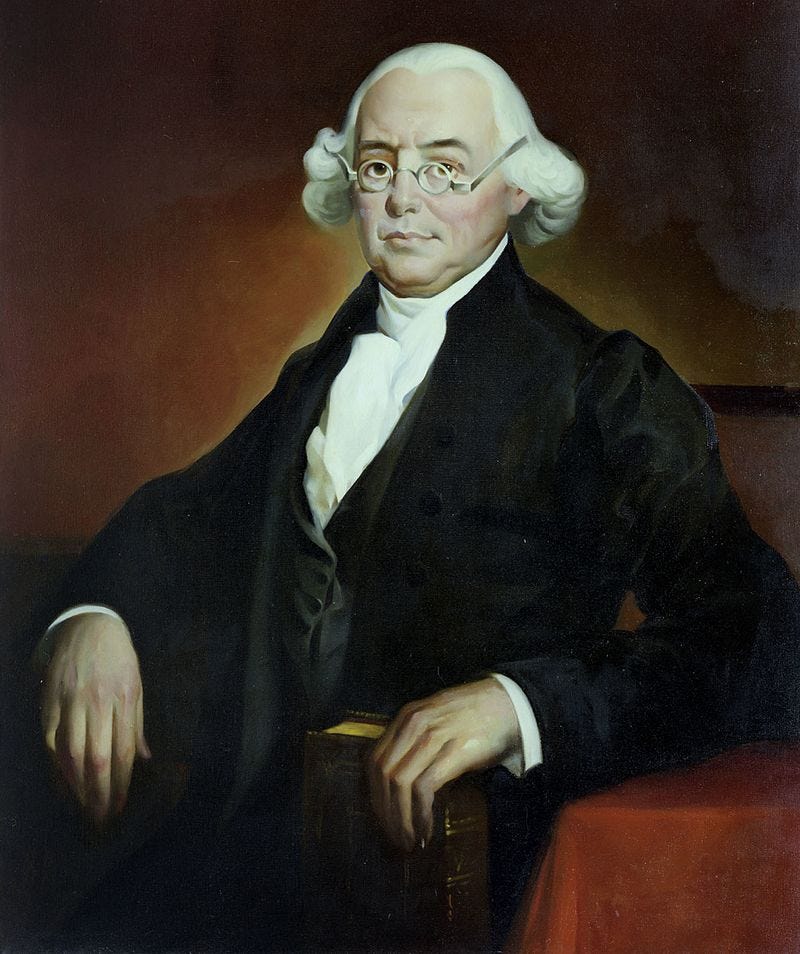
p.s. I append here a portrait of James Wilson, who came from Scotland to American in 1765 at the age of 23, served with me in the Congress of 1775-1776, and later in the Constitutional Convention. At present, he is one of the justices of the Supreme Court of the United States.
Interesting exchange, considering the fact that 14 years (as well as the other age ranges mentioned) was a rather considerable percentage of life expectancy at that time.