
Mr. Shapely
Letter 120
Kind Reader,
It seems to me that I have here too much indulged my own vanity, by publishing too often things I have written, or things others have written about me. So, for the sake of greater variety, I give you occasionally something that is not mine, but which I think worthy of your attention, either as instruction or amusement or both. As I wrote in one of my almanacs, “Why then should I give my readers bad lines of my own, when good ones of other people’s are so plenty? ‘Tis methinks a poor excuse for bad entertainment of guests, that the food we set before them, though coarse and ordinary, is of one’s own raising, off one’s own plantation, &c., when there is plenty of what it ten times better to be had in the market.”
I have long though that there are few examples of good English prose better than that which is found in The Spectator, the paper of Joseph Addison and Richard Steele. The fact that it has remained in print and popular all these years since its first publication in 1711 and 1712 demonstrates that I am not alone in this estimation. I confess that, as a youth, and as a young printer, I endeavored to model my own writing on that Mr. Addison, even to writing fictitious letters to my own paper under various pseudonyms when it suited my purpose. But then I was scarcely alone in that either.
Today I give you a Spectator that I thought quite diverting when I was young. I think Mr. Addison caught very well the manner of writing or speaking of girl of 13 in the letter of “B.D.” you will read in that paper. That you also will find “B.D.” amusing is the wish of
your friend and servant,
B. Franklin
_____________________________
THE SPECTATOR
London – September 4, 1712.
It is an old observation, which has been made of politicians who would rather ingratiate themselves with their sovereign than promote his real service, that they accommodate their counsels to his inclinations, and advise him to such actions only as his heart is naturally set upon. The Privy Counsellor of one in love mush observe the conduct, unless he would forfeit the friendship of the person who desires his advice. I have known of several odd cases of this nature.
Hipparchus was going to marry a common woman, but being resolved to do nothing without the advice of his friend Philander, he consulted him upon the occasion. Philander told him his mind freely, and represented his mistress to him in such strong colors that the next morning he received a challenge for his pains, and before twelve o’clock was run through the body by the man who had asked his advice.
Celia was more prudent on the like occasion; she desired Leonilla to give her opinion freely upon a young fellow who made his addresses to her. Leonilla, to oblige her, told her with great frankness that she looked upon him as one of the most worthless … Celia, foreseeing what a character she was to expect, begged her not to go on, for that she had been privately married to him above a fortnight.
The truth of it is, a woman seldom asks advice before she has bought her wedding clothes. When she has made her own choice, for form’s sake, she sends a congé d’elire [license to choose] to her friends.
If we look into the secret springs and motives that set people at work in these occasions, and put them upon asking advice which they never intend to take, I look upon it to be none of the least that they are incapable of keeping a secret which is so very pleasing to them. A girl longs to tell her confidante that she hopes to be married in a little time and, in order to talk of the pretty fellow that dwells so much in her thoughts, asks her very gravely, what she would advise her to do in a case of so much difficulty. Why else should Melissa, who had not a thousand pounds in the world, go into every quarter of the town to ask her acquaintance whether they would advise her to take Tom Townly, that made his addresses to her, with an estate of five thousand a year? ‘Tis very pleasant on this occasion to hear the lady propose her doubts, and see the pains she is at to get over them.
I must not omit a practice that is in use among the vainer part of our own sex, who will often ask a friend’s advice in relation to a fortune [an heiress] whom they are never likely to come at. Will Honeycomb, who is now on the verge of threescore, took me aside not long since, and asked me in his most serious look, whether I would advise him to marry my lady Betty Single who, by the way, is one of the greatest fortunes about town. I stared him full in the face upon so strange a question; upon which he immediately gave me an inventory of her jewels and estate, adding that he was resolved in a matter of such consequence without my approbation. Finding he would have an answer, I told him if he could get the lady’s consent, he had mine.
This is about the tenth match which, to my knowledge, Will has consulted his friends upon, without ever opening his mind to the party herself.
I have been engaged in this subject by the following letter, which comes to me from some notable young female scribe, who, by the contents of it, seems to have carried matters so far, that she is ripe for asking advice; but as I would not lose her good will, for forfeit the reputation I have with her for wisdom, I shall only communicate the letter to the public, without returning any answer to it.
Mr. Spectator,
Now, sir, the thing is this: Mr. Shapely is the prettiest gentleman about town. He is very tall, but not too tall neither. He dances like an angel. His mouth is made, I don’t know how, but ‘tis the prettiest that I ever saw in my life. He is always laughing, for he has an infinite deal of wit. If you did but see how he rolls his stockings! He has a thousand pretty fancies, and I am sure, if you saw him, you would like him. He is a very good scholar, and can talk Latin as fast as English. I wish you could but see him dance.
Now you must understand poor Mr. Shapely has no estate; but how can he help that, you know? And yet my friends are so unreasonable as to be always teasing me about him, because he has no estate. But I am sure he has that, that is better than an estate – for he is a good-natured, ingenious, modest, civil, tall, well-bred, handsome man, and I am obliged to him for his civilities ever since I saw him.
I forgot to tell you that he has black eyes, and looks upon me now and then as if he had tears in them.
And yet my friends are so unreasonable, that they would have me be uncivil to him.
I have a good portion which they cannot hinder me of, and I shall be fourteen on the 29th day of August next, and am therefore willing to settle in the world as soon as I can, and so is Mr. Shapely. But everybody I advise with here is Mr. Shapely’s enemy. I desire therefore that you will give me your advice, for I know you are a wise man; and if you advise me well, I am resolved to follow it. I heartily wish you could see him dance, and am, sir,
your most obedient, humble servant,
B. D.
p.s. He loves your Spectators mightily.
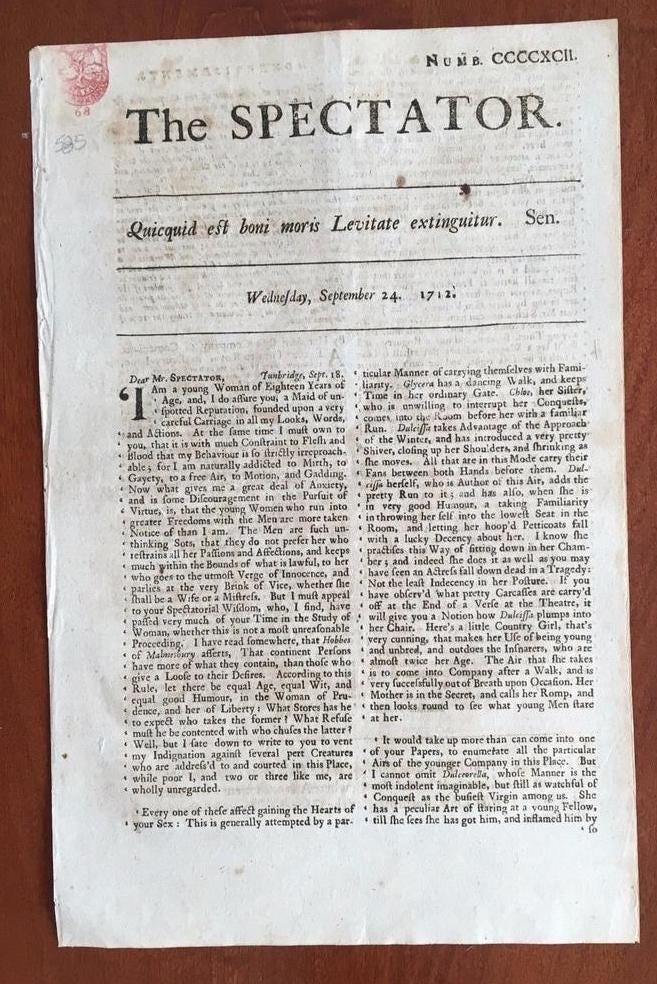
These folks make today's TV reality and bachelor shows, etc. look tame!!
Still funny!