
Smallpox
Letter 84
Kind Reader,
I regard it is an example of his great good sense that General Washington wisely required that all those who served as soldiers in our Continental Army undergo the smallpox by inoculation, even over their own objections.
I myself survived, at age 15, the epidemic of smallpox brought to Boston by H.M.S. Seahorse in 1721. It was during that deadly distemper, in which hundreds of my fellow townsmen perished, that inoculation (hitherto known in Africa and among the Turks) was first introduced into America by Dr. Zabdiel Boylston and the Rev. Cotton Mather. This practice, so beneficial to mankind, was received in Boston with a great deal of skepticism, and even violence. (One night a bomb was thrown through one of Mr. Mather’s windows, and its failure to explode was all that saved his family.) Experience, however, proved the efficacy of inoculation, and I have in the years since done all I might to encourage the practice
in my newspaper:
We hear from New England, that the smallpox spreads in diverse parts of the country. There is an account published of the number of persons inoculated in Boston in the month of March, amounting to seventy-two; of which two only died, and the rest have recovered perfect health. Of those who had it in the common way, ’tis computed that one in four died. Several hundreds have been inoculated, and but about four in the hundred have died under inoculation; and even those are supposed to have first taken the infection in the common way.
-- The Pennsylvania Gazette, May 14, 1730.
And in my almanac:
God offered to the Jews salvation
and ’twas refused by half the nation;
thus, (tho’ ’tis life’s great preservation)
many oppose inoculation.
-- Poor Richard’s Almanac for 1737.
And when my own son, my own dear little Franky, perished by the smallpox before he could be inoculated, I would not allow my personal sorrow to be used against so good a practice:
Understanding ’tis a current report, that my son Francis, who died lately of the smallpox, had it by inoculation; and being desired to satisfy the public in that particular; inasmuch as some people are, by that report (joined with others of the like kind, and perhaps equally groundless) deterred from having that operation performed on their children, I do hereby sincerely declare, that he was not inoculated, but received the distemper in the common way of infection. And I suppose the report could only arise from its being my known opinion, that inoculation was a safe and beneficial practice; and from my having said among my acquaintance, that I intended to have my child inoculated, as soon as he should have recovered sufficient strength from a flux with which he had been long afflicted.
-- The Pennsylvania Gazette, December 30, 1736.
I returned to this last sad event in that portion of my memoir written in 1784:
In 1736 I lost one of my sons, a fine boy of four years old, by the smallpox taken in the common way. I long regretted bitterly, and still regret, that I had not given it to him by inoculation. This I mention for the sake of parents, who omit that operation on the supposition that they should never forgive themselves if a child died under it; my example showing that the regret may be the same either way, and that therefore the safer should be chosen.
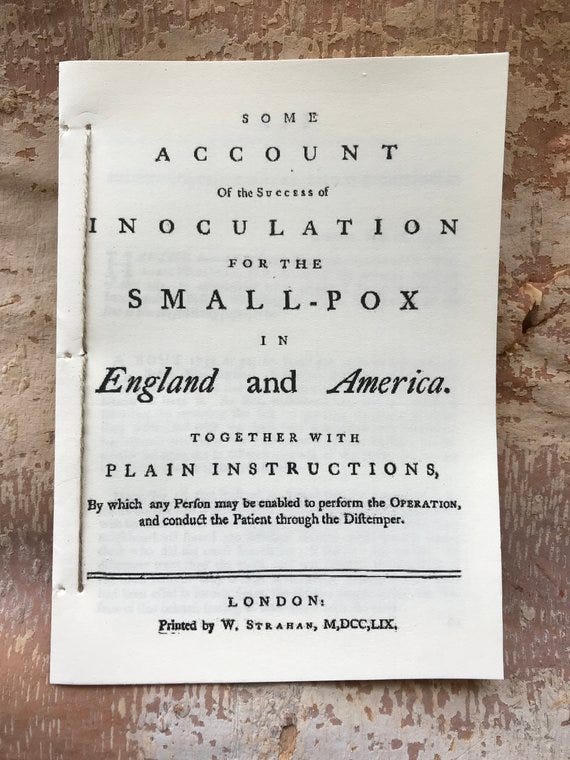
In 1758, I encouraged my friend Dr. William Heberden, F.R.S., to prepare a pamphlet that might provide to many the instruction and encouragement they required to inoculate their children. This was done by that good man, and the result, Some Account of the Success of Inoculation for the Smallpox in England and America, was published on February 16, 1759.
I give you today a portion of the lengthy preface I wrote to accompany Dr. Heberden’s pamphlet. Urging you, dear reader, to inoculate your children as soon as they are able to bear the operation, I am
you friend and humble servant,
B. Franklin
______________________________________
Notwithstanding the now uncontroverted success of inoculation, it does not seem to make that progress among the common people in America, which at first was expected. Scruples of conscience weigh with many, concerning the lawfulness of the practice; and if one parent or near relation is against it, the other does not choose to inoculate a child without free consent of all parties, lest in case of a disastrous event, perpetual blame should follow. These scruples a sensible clergy may in time remove. The expense of having the operation performed by a surgeon, weighs with others, for that has been pretty high in some parts of America; and where a common tradesman or artificer has a number in his family to have the distemper, it amounts to more money than he can well spare. Many of these, rather than own the true motive for declining inoculation, join with the scrupulous in the cry against it, and influence others. A small pamphlet wrote in plain language by some skillful physician, and published, directing what preparations of the body should be used before the inoculation of children, what precautions to avoid giving the infection at the same time in the common way, and how the operation is to be performed, the incisions dressed, the patient treated, and on the appearance of what symptoms a physician is to be called, &c., might be encouraging parents to inoculate their own children, be a means of removing that objection of the expense, render the practice much more general, and thereby save the lives of thousands.
The doctor [i.e. Dr. William Heberden, F.R.S.], after perusing and considering the above, humanely took the trouble (though his extensive practice affords him scarce any time to spare) of writing the following plain instructions, and generously, at his own private expense, printed a very large impression of them, which was put into my hands to be distributed gratis in America. Not aiming at the praise which however is justly due to such disinterested benevolence, he has omitted his name; but as I thought the advice of a nameless physician might possibly on that account be less regarded, I have without his knowledge here divulged it. And I have prefixed to his small but valuable work these pages, containing the facts that gave rise to it; because facts generally have, as indeed they ought to have, great weight in persuading to the practice they favor. o these I may also add an account I have been favored with by Dr. Archer, physician to the smallpox hospital here, viz.
There have been inoculated in this hospital since its first institution to this day, December 31, 1758: 1,601 persons; of which number died 6.
Patients who had the smallpox in the common way in this hospital, to the same day, 3,856; of which number died 1,002.
By this account it appears, that in the way of inoculation there has died but one patient in 267, whereas in the common way there had died more than one in four. The mortality indeed in the latter case appears to have been greater than usual, (one in seven, when the distemper is not very favorable, being reckoned the common loss in towns by the smallpox, all ages and ranks taken together) but these patients were mostly adults, and were received, it is said, into the hospital, after great irregularities had been committed. By the Boston account [cited in a part of this piece not included in this extract] it appears, that, whites and blacks taken together, but about one in eleven died in the common way, and the distemper then was therefore reckoned uncommonly favorable. I have also obtained from the foundling hospital, (where all the children admitted, that have not had the smallpox, are inoculated at the age of five years) an account to this time of the success of that practice there, which stands thus, viz.
Inoculated, boys 162, girls 176, in all 338; of these died in inoculation, only 2; and the death of one of those two was occasioned by a worm fever.
On the whole, if the chance were only as two to one in favor of the practice among children, would it not be sufficient to induce a tender parent to lay hold of the advantage? But when it is so much greater, as it appears to be by these accounts (in some even as thirty to one) surely parents will no longer refuse to accept and thankfully use a discovery God in his mercy has been pleased to bless mankind with; whereby some check may now be put to the ravages that cruel disease has been accustomed to make, and the human species be again suffered to increase as it did before the smallpox made its appearance. ...
B. Franklin, of Philadelphia.
________________________________
NB: Inoculation is not to be confused with the much easier and safer practice of vaccination, which was devised by Edward Jenner in 1796.
Excellent commentary, Dr. Franklin! You are always a greatly appreciated champion of this much needed medical practice. My thanks for your numerous and persuasive writings on this subject.