
Tahiti
Letter 102
Kind Reader,
The good reverend Bishop of St. Asaph, Dr. Jonathan Shipley, most kindly invited me to spend the summer of 1771 with his family at Twyford House, his estate near Winchester. It was while there that I wrote the first part of my memoirs, with which you may be familiar. One of the great events of that summer was Captain James Cook’s return from his three-year’s circumnavigation of the globe. His ship, the Endeavor, had departed England in August, 1768, and was not seen again until it sailed into Dover on July 12, 1771.
Captain Cook had been dispatched by the Royal Society to make observations of the transit of Venus across the face of the sun, from that point as directly opposite the observatory at Greenwich as might be: specifically, the island of Tahiti in the South Seas, a place first visited by Europeans only a year before Cook sailed.
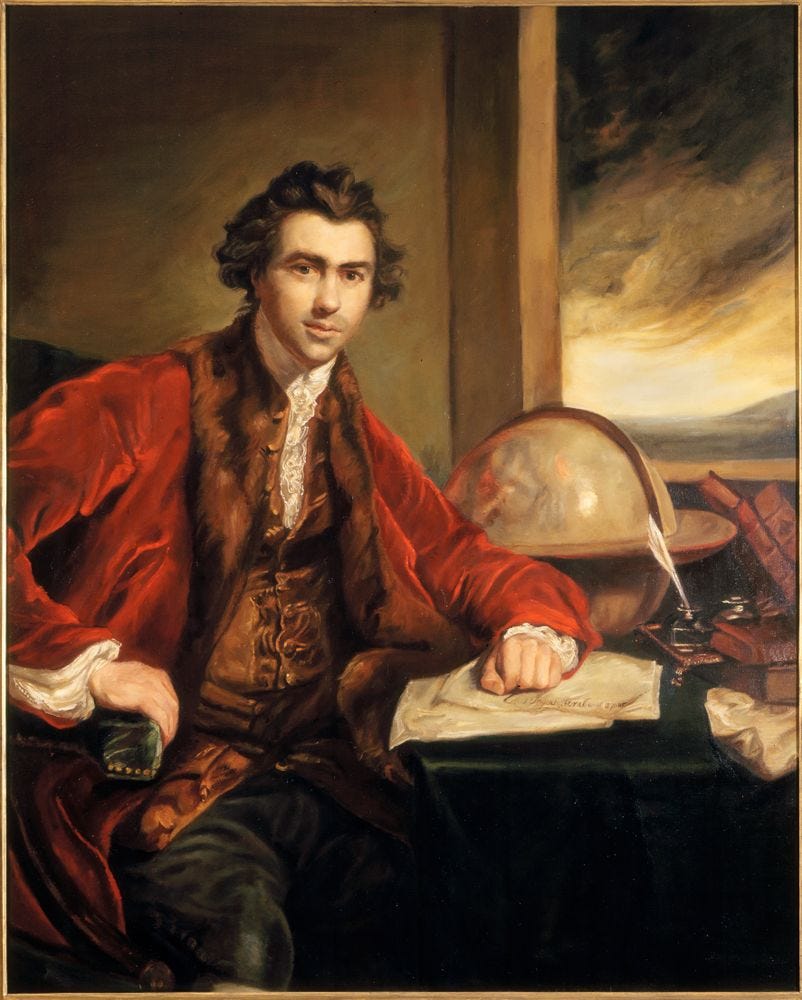
Two naturalists sailed on the Endeavor to make the astronomical observations, as also to collect specimens of plants and animals in the countries visited, and to take a view of the inhabitants of the places visited, such as New Holland (or “Australia” as it is now called). They were Joseph Banks (then but 25 years old, but now Sir Joseph Banks, president of the Royal Society) and a Swedish botanist, Daniel Solander, a pupil of celebrated Carl Linnaeus.
Volumes could be filled with their observations and discoveries. I was particularly delighted to hear than the Endeavor was equipped with a lightning conductor that did the expedition good service.
Dr. Shipley is particularly interested in accounts of distant peoples, and I was given the opportunity to somewhat satisfy his curiosity when I had the honor to meet these two naturalists at the home of another old friend, not long after leaving the Shipley family. I give you today the letter I wrote to His Lordship soon after that meeting. That you will find it as interesting as did that gentleman is the wish of
your friend and humble servant,
B. Franklin
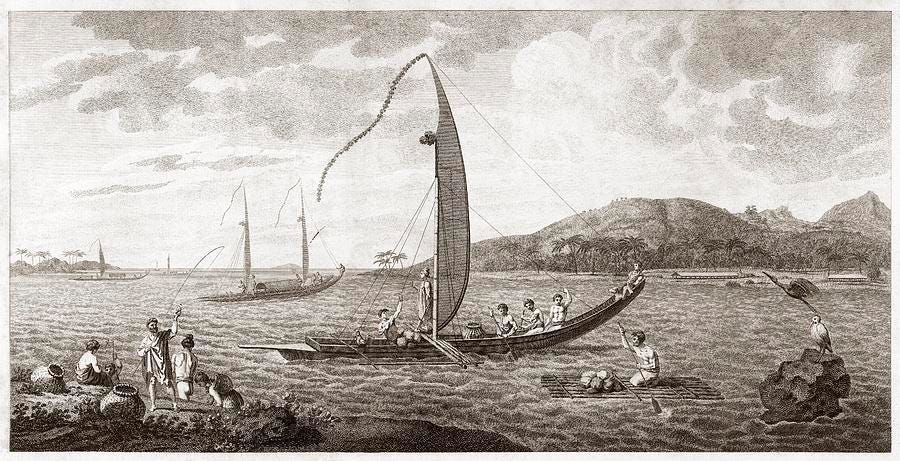
p. s. I attach a portrait of Mr. Banks painted in 1773 and along with it a picture of Tahiti.
__________________
London -- August 19, 1771.
My Lord,
By the Southampton Coach, I have sent your Lordship the book of State Trials, which would have been sent sooner but that I hoped to send the Northumberland book with it. I have searched and enquired among my friends for that book, and cannot find it. I suppose I have lent it, and do not yet recollect to whom.
I dined on Sunday last at Sir John Pringle’s with Messrs. Banks and Solander, and learnt some farther particulars. The people of Otahitee (George’s Island) are civilized in a great degree, and live under a regular feudal government, a supreme lord or king, barons holding districts under him, but with power of making war on each other: farmholders under the barons; and an order of working people, servants to the farmholders.
They believe in a supreme god, and inferior gods, all spirits, with a celestial government similar to their own. They have some ceremonies of adoration, but seldom used. They erect temples for their gods; but they are small and stuck up on a pole in the fields, partly to honor the gods, and partly for their convenience to lodge in when they happen to come down among men: a little temple being, they say, as commodious for a spirit as a large one.
Their morals are very imperfect, as they do not reckon chastity among the virtues, nor theft among the vices.
They have honors and distinctions belonging to different ranks, but these are paid to a father no longer when he has a son born, they are afterwards paid only to that son; and this keeps some from marrying who are unwilling to lose their rank, and occasions others to kill their children that they may resume it.
They had no idea of kissing with the lips, it was quite a novelty to them, though they liked it when they were taught it. Their affectionate and respectful salutation is bringing their noses near each other’s mouths and snuffing up one another’s breath.
Their account of the creation is, that the Great Spirit first begot the waters, then he begot the earth and threw it, a great mass, into the waters; then not liking to see it all in one place, and a great part of the waters without any of it, he fastened a strong cord to it, and drew it so swiftly through the waters that many of the loose parts broke off from it and remain in the sea, being the islands they are acquainted with. They believe the great mass is still in being somewhere, though they know not where; and they asked our people if they did not come from it.
They have a considerable knowledge of the stars, sail by them, and make voyages of three months westward among the islands. Notwithstanding all the advantages our people could show we had from our arts, &c., they were of opinion after much consideration that their condition was preferable to ours.
The inhabitants of New Zealand were found to be a brave and sensible people, and seemed to have a fine country.
The inhabitants of New Holland seemed to our people a stupid race, for they would accept none of our presents. Whatever we gave them, they would look at a while, then lay it down and walk away. Finding four children in a hut on one part of the coast, and seeing some people at a distance who were shy and would not be spoke with, we adorned the children with ribbons and beads, and left with them a number of little trinkets and some useful things; then retiring to a distance, gave opportunity to the people to fetch away their children, supposing the gifts might conciliate them: but coming afterwards to the hut, we found all we had left, the finery we had put upon the children among the rest. We call this stupidity. But if we were disposed to compliment them, we might say, “Behold a nation of philosophers! such as him whom we celebrate for saying as he went through a fair, “How many things there are in the world that I don’t want!”
Please to present my best respects to good Mrs. Shipley. Her kind letter has relieved me from an uneasiness I was under lest by some sottise [i.e. folly] or other in my long hasty scrawl I might have given offence. My love to all the young ladies accompanies the sincere and great esteem and respect with which I am, My Lord,
your Lordship’s most obedient and most humble servant,
B Franklin
Speaking of Captain Cook, Benjamin Franklin personally saw to it that he would not be treated as an enemy during his third voyage, which took place during the Revolution. Instead, Franklin wrote to American captains and asked them to treat Cook as a man of science and render him any aid that he may need.